On this page
The world of medicine and biotechnology continues to develop revolutionary methods—reminiscent of science fiction—to treat total vision loss once considered "irreversible." Representing the pinnacle of these miraculous developments and serving as the brightest light at the end of the tunnel for patients who have completely lost their sight, Optogenetic Therapies have opened the doors to a new era in ophthalmology.
What is Optogenetic Therapy?
In hereditary retinal diseases (such as advanced-stage Retinitis Pigmentosa), the primary light-sensing cells, the photoreceptors (rods and cones), completely die over time. When photoreceptors are lost, standard gene therapies (such as Luxturna) become ineffective because there are no living cells left for the therapy to repair.
However, miraculously, even when photoreceptors are completely gone, the underlying layers of the retina containing "ganglion cells" or "bipolar cells" (which normally do not sense light) remain healthy. The cable connection between the eye and the brain (the optic nerve) stays intact.
"Optogenetics" is the perfect fusion of light (opto) and genetic science. The primary goal of this treatment is to use genetic engineering to grant "light sensitivity" to these remaining layers of the retina. In other words, standard transmitter cells inside the eye are transformed into "artificial photoreceptors" via genetic coding, enabling the eye to perceive light again and send visual signals to the brain.
How Does Optogenetic Therapy Work? (A Three-Stage Miracle)
The working mechanism of optogenetic therapy is a highly sophisticated, multi-component process:
Stage 1: Injecting the Genetic Code
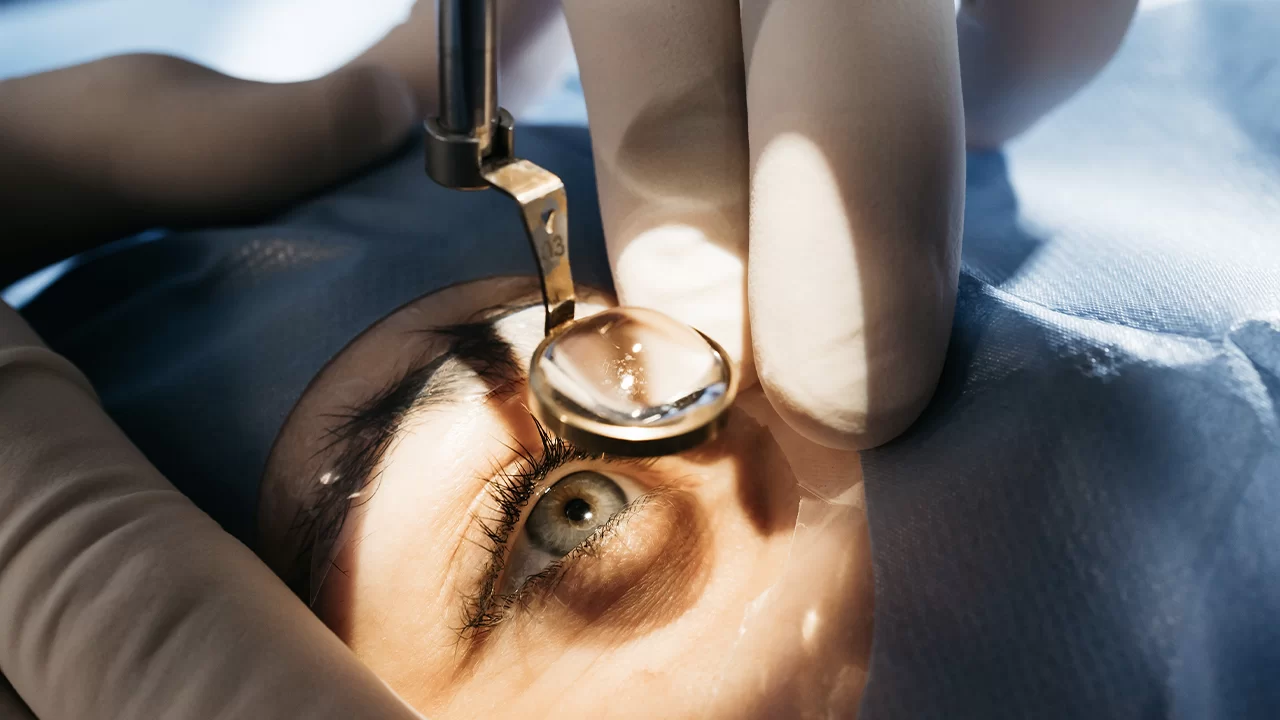
Light-sensitive proteins (opsins) are found in nature in certain algae and bacteria. In a laboratory setting, the genetic codes to produce these proteins are loaded into harmless, specialized viral vectors. Through a precise and painless intravitreal injection performed in the operating room, this genetic material is transferred to the healthy ganglion cells in the patient's retina.
Stage 2: Cellular Transformation (Protein Production)
In the months following the injection, the patient's retinal cells begin to read this new genetic code and produce light-sensitive proteins (e.g., ChrimsonR) on their surface. Thus, cells that normally cannot see light transform into next-generation sensors capable of responding to light.
Stage 3: Biomimetic (AI-Powered) Goggles
These newly produced proteins are designed to react not to ambient daylight, but to very specific wavelengths of light (usually amber or red pulses). Therefore, the patient cannot see the world directly with the naked eye. The most critical component of the treatment is a high-tech biomimetic goggle worn by the patient. A camera on these goggles records objects and movements in real-time. A microprocessor inside the goggles converts these images into specific light pulses that the new proteins in the retina can detect and reflects them directly into the eye. The cells receive this light and transmit it to the brain as an "image."
Who is It Suitable For? (Gene-Agnostic Treatment)
The most revolutionary aspect of optogenetic therapy is that it is "gene-agnostic." While standard gene therapies can only treat patients with a mutation in one specific gene (e.g., RPE65), optogenetics does not care which gene caused the disease.
It serves as a beacon of hope for:
- Patients with advanced-stage Retinitis Pigmentosa who have completely lost their photoreceptor cells.
- Patients who are totally blind or have only light perception due to advanced hereditary macular dystrophies or other retinal degenerations.
- Hereditary retinal patients who do not carry the specific genes required for standard gene therapies.
Visual Rehabilitation: Relearning to See
Optogenetic therapy is more than just an injection; it is a long-term process requiring the brain to be reconfigured. The signals sent to the retina by the goggles are different from natural vision. Initially, the patient perceives only flashes of light or silhouettes.
Success depends on intensive "Visual Rehabilitation (Biofeedback)" training provided at our clinic. Thanks to neuroplasticity, the brain learns to interpret these new signals over time. After months of training, patients gain life-changing abilities such as locating objects on a table, detecting and avoiding obstacles, finding doors, and perceiving crosswalk lines.
Frequently asked questions
What is optogenetic therapy? Is it science fiction or a real treatment?
Optogenetics is a revolutionary, entirely real, and ground-breaking treatment in the medical world. In diseases like Retinitis Pigmentosa, light-sensing cells (photoreceptors) die completely, and the patient is plunged into pitch darkness. Optogenetic therapy is the process of using genetic intervention to grant "light-sensing ability (photosensitivity)" to other surviving cells in the back of the eye that are not normally sensitive to light. In other words, it is the creation of a brand-new, artificial biological camera inside the eye.
What is the difference between Gene Therapy and Optogenetics?
Gene therapy (e.g., Luxturna) repairs the defective gene inside "sick" cells that have not yet died; therefore, it only works for early/middle-stage patients. Optogenetics, however, is the only genetic hope developed for end-stage patients experiencing total blindness, where photoreceptor cells have completely died and "no living cells remain."
How is suitability for optogenetic treatments assessed?
Optogenetic treatments are applied worldwide within clinical research and in specific patient groups. With microperimetry, ERG and FAF tests, whether a patient is a candidate for these studies or approved treatments can be reported according to ISCEV standards.
This content is for information only; please consult your physician for diagnosis and treatment.