On this page
After a successful cataract surgery, leaving behind misty days to see the world’s colors clearly again feels like a "second spring" for our patients. However, months or even years later, some patients may notice their vision gradually becoming blurry again, much like their old cataract days. While this is often expressed with the concern that "my cataract has returned," it is actually a natural cellular reaction known in medical literature as Posterior Capsule Opacification (Secondary Cataract).
As Ophthalmology Specialist Ayşe Öner and her high-tech clinical team, we eliminate this blurriness in minutes using YAG Laser Capsulotomy—a scalpel-free, needle-free, and entirely painless method.
What is Posterior Capsule Opacification (Secondary Cataract)?
During cataract surgery (the PHACO method), your natural lens is removed, but the transparent "capsule" that surrounds it is intentionally left in place. This clear back wall acts like a thin membrane, providing vital support to keep your new Artificial Intraocular Lens (IOL) perfectly in its housing.
Secondary Cataract occurs when microscopic epithelial cells grow on or behind this transparent membrane over time, making the capsule opaque like frosted glass.
The most important fact for our patients is this: Cataracts never return. An artificial lens cannot develop a cataract. Only the membrane the lens sits on becomes clouded. This is not a complication related to the surgeon's success or the quality of the lens, but a natural cellular healing reflex of the body.
Symptoms of Secondary Cataract
When the posterior capsule becomes opaque, patients typically experience complaints very similar to those they had before their initial cataract surgery:
- Decline in Visual Acuity: Vision that was very clear after surgery becomes smoky, misty, or foggy over months or years.
- Light Sensitivity (Glare) and Halos: Scattering of lights and the formation of rings around them, especially during night driving or in bright sunlight.
- Faded Color Perception: Perceiving colors as yellowish or dull.
- Difficulty Reading: Struggling with small print, threading a needle, or detailed work despite using reading glasses.
How is YAG Laser Capsulotomy Performed? (The Seconds-Long Solution)
To clear this clouded membrane, there is absolutely no need to re-enter an operating room, cut the eye, or replace the lens. Dr. Ayşe Öner permanently solves this issue in an office setting in just seconds using a high-tech Nd:YAG Laser device.
- Preparation with Drops: About 15-20 minutes before the procedure, special drops are used to dilate the pupil and lightly numb the eye surface. No needles or anesthesia are required.
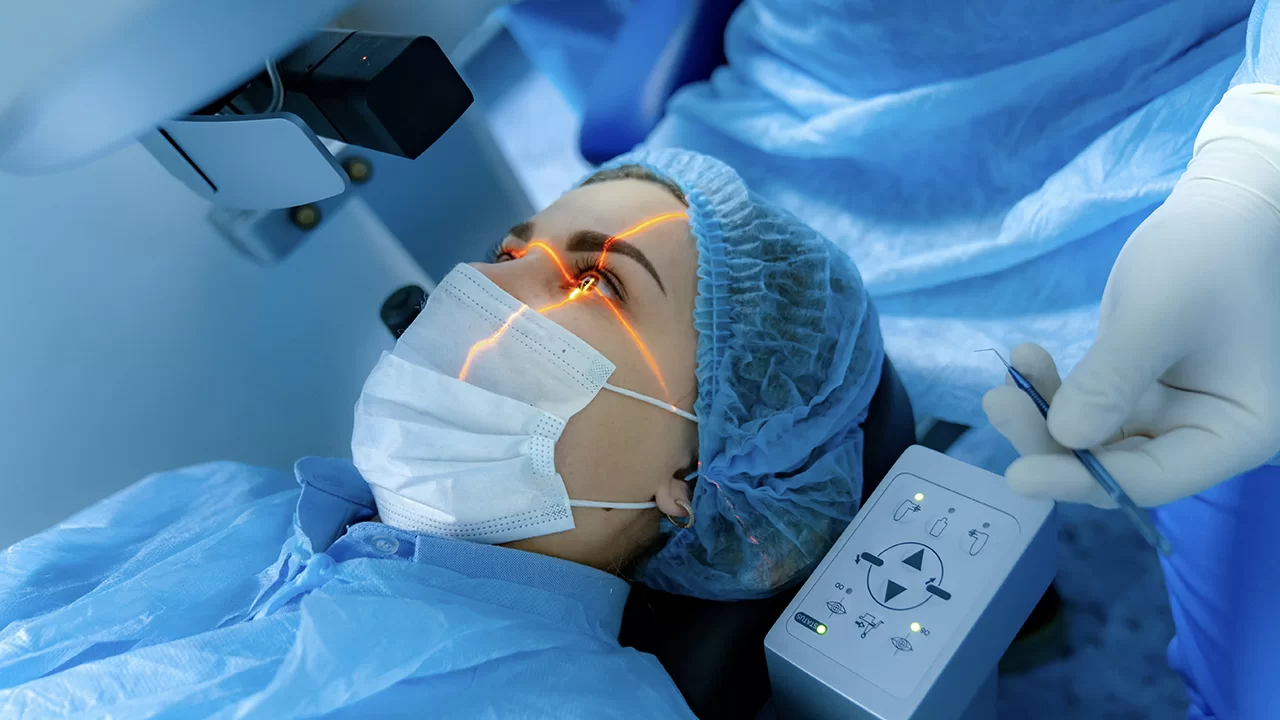
- The Laser Procedure: The patient sits at the laser device, similar to a standard eye exam. The specialist focuses a millimetric laser beam onto the clouded capsule. The laser energy creates a small "window" (opening) in the center of the membrane without touching the eye or damaging the artificial lens.
- Painless and Fast: The process takes only 1 to 2 minutes per eye. You will only see a red light and hear a "clicking" sound; you will feel no pain, stinging, or discomfort.
Recovery and Expectations
Recovery begins immediately after the YAG laser. Vision may remain slightly blurry for a few hours due to the dilating drops, but by the evening or the next day, vision typically returns to the crystal-clear state experienced right after the initial cataract surgery.
- No Bandages: You can walk out of the clinic and return to your social life immediately.
- Floaters: You may see tiny "floaters" or "threads" for a few days as the microscopic particles of the opened membrane settle. This is normal and they disappear over time.
- Medication: Mild anti-inflammatory eye drops are used for just a few days.
- Permanent Solution: Once the membrane is opened with the YAG laser, it does not close again; this procedure is generally performed only once in a lifetime.
Frequently asked questions
I had a successful cataract surgery years ago, but my eye is cloudy again. Does a cataract recur?
This is a situation that our patients worry about most, but it has the easiest solution. "Cataracts never recur." What you are experiencing is known as "Secondary Cataract (Posterior Capsule Opacification - PCO)." That membrane-thin capsule, inside which the artificial lens is placed during cataract surgery, can become cloudy or dirty on its own months or years later, blocking vision like frosted glass. This is an entirely normal and expected situation.
Will I need surgery again to clean this frosted glass in my eye?
Absolutely not. To treat this condition, there is no need to enter the operating room again, receive anesthesia, or have your eye cut. The procedure is entirely an outpatient application. Your eye is numbed with just a drop, and you rest your chin in front of the device. Dr. Ayşe Öner opens a "window (hole)" in that soiled membrane within seconds using a YAG Laser device. You do not feel any pain.
How long does a YAG laser procedure take, and can I return to daily life afterwards?
After the examination, the pupil is dilated with drops and the YAG laser procedure, which takes about 1 minute, is performed. No eye patch or stitches are needed afterwards; you can return to your normal life immediately.
This content is for information only; please consult your physician for diagnosis and treatment.


