On this page
Childhood is the most precious period for discovering the world, learning, and brain development. Our sense of sight is the primary architect of this growth. However, during these early years, an eye that appears perfectly healthy from the outside may gradually lose its function because the brain begins to reject its visual signals. Known as Amblyopia in medical literature, this silent condition can lead to permanent lifelong vision loss and the disappearance of depth perception if not diagnosed early.
As Ophthalmology Specialist Ayşe Öner and her clinical team—highly experienced in pediatric ophthalmology and neuro-visual rehabilitation—we offer the most modern, interactive, and scientific methods for the diagnosis and treatment of lazy eye to our patients.
What is Lazy Eye (Amblyopia)?
Lazy eye is a condition where the vision capacity of an eye fails to reach normal levels (100%), even though there is no anatomical or structural damage (tears, scars, tumors, etc.) to the eyeball itself. This problem actually occurs in the brain, not the eye.
Vision happens when light signals received by the eye are transmitted via the optic nerve to the visual cortex at the back of the brain. The first 7-8 years of life (especially the first 3) are the critical window where the brain "learns to see" and establishes cellular connections (neuroplasticity). If the brain receives a blurred or distorted image from one eye during this period, it begins to reject (suppress) that low-quality input. It only accepts images from the "strong and clear" eye. Over time, the neural connections between the brain and the unused eye weaken, and the eye becomes "lazy." Without treatment, that eye will never see fully, even with glasses.
Primary Causes of Lazy Eye
Three main factors typically cause the brain to ignore one eye:
- Strabismus (Strabismic Amblyopia): The most common cause. If one eye looks straight while the other turns inward or outward, the brain receives two different images. To prevent double vision (diplopia), the child's brain "shuts down" the image from the misaligned eye.
- Refractive Errors (Anisometropic Amblyopia): The most insidious type. No misalignment is visible from the outside. However, if one eye has a low prescription while the other has high hyperopia, myopia, or astigmatism, the brain only uses the clear eye and suppresses the blurry one.
- Visual Deprivation (Deprivation Amblyopia): The most severe type requiring urgent intervention. It develops when light is physically blocked from entering the eye, often due to congenital cataracts, a drooping eyelid (ptosis), or corneal scars.
Symptoms: What Should Families Look For?
Since lazy eye usually affects only one eye, children often don't realize they have a problem because they see perfectly well with their strong eye. Parents should watch for:
- Sitting very close to the television or leaning deeply over books.
- Squinting or closing one eye when focusing or in bright sunlight.
- Tilting the head to a specific side while examining objects.
- Clumsiness, tripping on stairs, or difficulty judging distances (indicating loss of depth perception).
- A visible misalignment or wandering of the eyes.
Diagnosis and Advanced Pediatric Screening
While treatment is highly successful up to ages 7-8, the success rate drops dramatically after age 10. At Dr. Ayşe Öner Clinic, we use high-tech systems that work even for children who cannot yet read:
- Pediatric Autorefractors: Devices that measure the eye prescription from a 1-meter distance in seconds without the child needing to look into a lens.
- Stereovision Tests: Interactive visual tests to determine the state of the child's depth perception.
Treatment Methods: Re-teaching the Brain to See
Treating lazy eye is a "rehabilitation" process that requires patience.
- Correcting the Cause: If a cataract or drooping eyelid is present, it is surgically corrected first. If the issue is a refractive error, the correct optical glasses are prescribed immediately.
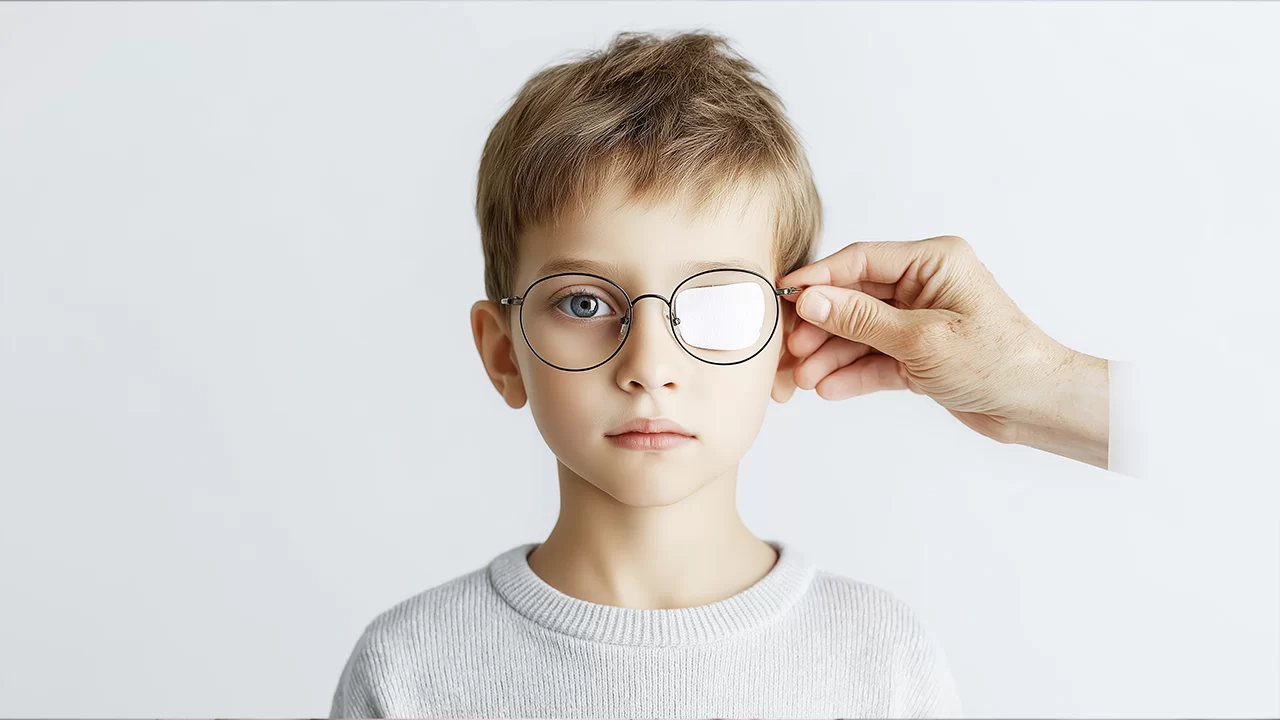
- Patching Therapy (The Gold Standard): The strong eye is covered with a special patch for several hours a day (e.g., 2-4 hours). This forces the brain to use the weak eye and strengthens the neural connections.
- Neuro-Visual Rehabilitation: In addition to patching, we use interactive computer programs and Virtual Reality (VR) games designed to speed up cellular awakening and teach the brain to use both eyes simultaneously (binocular vision).
Frequently asked questions
How can I tell if my child has a lazy eye? Is the "age limit of 10" for treatment true?
Lazy eye (Amblyopia) occurs when the eye appears anatomically healthy, yet the brain ignores the image from that eye because it "never learned to see." Since it usually affects only one eye and the other eye sees well, children often do not notice it, and it may not be visible from the outside. This is why routine, detailed eye exams by age 3–4 are life-saving. While conventional medicine states there is "no treatment after age 10–12," our clinic utilizes neuro-visual rehabilitation methods focused on neuroplasticity (the brain's ability to reprogram itself) to achieve vision increases even in advanced ages.
Do you have an innovative solution other than the classic "eye patching" that doesn't bore children?
The old "pirate patch" treatments, which last for months and often cause children to avoid school or feel psychological pressure, are no longer the only option. We directly stimulate the brain using visionary methods. Through Special Orthoptic Exercises, CAM Treatment, and Interactive Computerized Vision Therapy, the visual capacity of the lazy eye in both children and adults is permanently increased in a much shorter time through engaging, non-tiring sessions.
How much time should I set aside for lazy eye training?
Lazy eye treatment is a visual training and exercise process similar to physiotherapy. At the initial assessment, the degree of amblyopia is measured. Exercise programs are usually planned as 10–15 sessions on consecutive days, followed by home exercises and special glasses.
This content is for information only; please consult your physician for diagnosis and treatment.


